



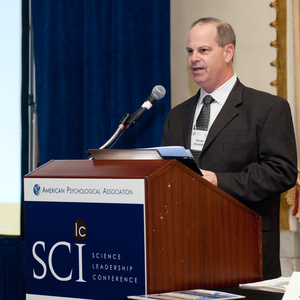

Steven Breckler
Steven J. Breckler was program director for social psychology at the National Science Foundation. Steve previously served as executive director of the American Psychological Association's Science Directorate. There he was responsible for programs that support advanced training for scientists, science policy and government relations, testing and assessment, research regulations and workforce analysis. Breckler was appointed to this post in 2004 and left at the end of 2014.
Before joining APA, Breckler directed the National Science Foundation's Social Psychology Program. He also helped to design NSF’s Science of Learning Centers program, which bring together scientists of various disciplines to advance understanding of learning.
Breckler was formerly associate professor of psychology at Johns Hopkins University. He is author or coauthor of more than 60 published or conference papers on topics ranging from attitude development to jury functioning, and his research has been supported by the National Institutes of Health, the National Science Foundation and the Department of Defense. Breckler was also the recipient of an NSF Presidential Young Investigator Award. His current research interests include the study of attitude ambivalence, and the development of best practices in open science.
Primary Interests:
- Applied Social Psychology
- Attitudes and Beliefs
- Emotion, Mood, Affect
- Persuasion, Social Influence
- Research Methods, Assessment
- Social Cognition
Note from the Network: The holder of this profile has certified having all necessary rights, licenses, and authorization to post the files listed below. Visitors are welcome to copy or use any files for noncommercial or journalistic purposes provided they credit the profile holder and cite this page as the source.
Image Gallery
Video Gallery
The Association for Psychological Science 2010: The Future of Clinical Psychology
Books:
- Breckler, S. J., Olson, J. M., & Wiggins, E. C. (2006). Social psychology alive. Belmont, CA: Wadsworth.
- Pratkanis, A. R., Breckler, S. J., & Greenwald, A. G. (Eds.). (1989). Attitude structure and function. Hillsdale, NJ: Erlbaum.
Journal Articles:
- Breckler, S. J. (2014). English is the global language of science [Review of the book Does science need a global language? English and the future of research, by S. L. Montgomery]. PsycCritiques, 59(14). DOI: 10.1037/a0036272
- Breckler, S. J. (1990). Applications of covariance structure modeling in psychology: Cause for concern? Psychological Bulletin, 107, 260-273.
- Breckler, S. J. (1994). A comparison of numerical indexes for measuring attitude ambivalence. Educational and Psychological Measurement, 54, 350-365.
- Breckler, S. J. (1994). Memory for the experience of donating blood: Just how bad was it? Basic and Applied Social Psychology, 15, 467-488.
- Breckler, S. J. (1984). Empirical validation of affect, behavior, and cognition as distinct components of attitude. Journal of Personality and Social Psychology, 47, 1191-1205.
- Breckler, S. J. (2015). Full STEM ahead: Understanding pressures to grow the scientific workforce [Review of the book Falling behind? Boom, bust & the global race for scientific talent, by M. S. Teitelbaum]. PsycCritiques. 60(13). DOI: 10.1037/a0039029
- Breckler, S. J., & Fried, H. (1993). On knowing what you like and liking what you smell: Attitudes depend on the form in which the object is represented. Personality and Social Psychology Bulletin, 19, 228-240.
- Breckler, S. J., & Wiggins, E. C. (1989). Affect versus evaluation in the structure of attitudes. Journal of Experimental Social Psychology, 25, 253-271.
- Breckler, S. J., & Wiggins, E. C. (1991). Cognitive responses in persuasion: Affective and evaluative determinants. Journal of Experimental Social Psychology, 27, 180-200.
- Nosek, B. A., Alter, G., Banks, G. C., Borsboom, D., Bowman, S. D., Breckler, S. J., et al. (2015). Promoting an open research culture: Author guidelines for journals could help to promote transparency, openness, and reproducibility. Science, 348(6242), 1422-1425. DOI: 10.1126/science.aab2374
Other Publications:
- Breckler, S. J. (2017). Social psychology and national science policy. In R. Zweigenhaft and E. Borgida (Eds.), Collaboration in psychological science: Behind the scenes. New York, NY: Worth Publishers.
- Breckler, S. J. (1993). Emotion and attitude change. In M. Lewis & J. Haviland (Eds.), Handbook of Emotions (pp. 461-473). New York: Guilford Publications.
- Breckler, S. J. (1999). Persuasion. Entry in D. Levinson, J. Ponzetti, & P. Jorgensen (Eds.), Encyclopedia of Human Emotions. New York, NY: Macmillan Reference.
- Breckler, S. J. (2004). Hold still while I measure your attitude: Assessment in the throes of ambivalence. In G. Haddock & G. Maio (Eds.), Contemporary Perspectives on the Psychology of Attitudes (pp. 77-91). Hove: Psychology Press.
- Wiggins, E. C., & Breckler, S. J. (1992). Management of complex civil litigation. In D. K. Kagehiro & W. S. Laupher (Eds.), Handbook of Psychology and Law (pp. 77-94). New York: Springer-Verlag.
Courses Taught:
- Attitudes and Social Influence
- Introduction to Developmental Psychology
- Introduction to Social Psychology
- Laboratory Methods in Social Psychology
- Multivariate Statistical Methods
Steven Breckler
United States of America
